BUSINESS
Quality Certification
AI Trustworthiness Certification
Overview
The AI Trustworthiness Certification evaluates safety, transparency, bias, and explainability in line with international standards, ensuring that AI systems provide trustworthy performance.
[International standards]
ISO/IEC TS 25058 - Guidance for the Evaluation of AI System Quality
ISO/IEC 25059 - Quality Model for AI Systems
ISO/IEC TR 24028 - Overview of Trustworthiness in AI
ISO/IEC TR 24027 - Bias in AI Systems and AI-Aided Decision Making
ISO/IEC TS 4213 - Assessment of Machine Learning Classification Performance
Certification benefits
- Enhancing the trustworthiness of products and services
- Strengthening market competitiveness and improving brand image
- Complying proactively with AI regulations and trustworthiness standards
- Preventing consumer safety incidents through risk management
AI Trustworthiness Pilot Certification
WISESTONE, in collaboration with the Korea Standards Association (KSA), has been selected as a business operator for the
"Private AI Trustworthiness Pilot Certification" based on the "Trustworthy AI Realization Strategy (May 2021, jointly conducted by relevant ministries)"
led by the Ministry of Science and ICT and the National IT Industry Promotion Agency.
WISESTONE and the Korea Standards Association (KSA) will establish a certification system,
including verification procedures, items, and methods, to objectively verify the reliability of AI. They will conduct pilot certifications for actual AI products and software.
Purpose of the Pilot Certification
- Prevent accidents caused by reliability and ethical issues in artificial intelligence
- Enhance industrial utilization by ensuring the reliability of AI products
- Promote the development of new industries that adopt AI-based products and software
- Foster a sound and responsible AI culture throughout society
Key Activities
- Conduct pilot certifications in advance to ensure stable operation of the certification system
- Establish a reliable testing and certification framework for artificial intelligence
- Support voluntary disclosure of reliability information to enhance the credibility of certified companies
- Promote and expand private-sector certification through external outreach and awareness activities
Certification Targets
-
Knowledge-Based AI
AI systems that provide services based on accumulated knowledge- - Predictive systems
- - Personalized recommendation systems
- - Medical diagnosis
-
Natural Language Processing (NLP)
AI functions that recognize and understand user language to provide services- - Machine translation
- - Document summarization
- - Conversational chatbots
-
Speech Recognition
AI functions that convert human speech into words or sentences to perform commands- - AI speakers
- - AI assistants
- - Voice-enabled home appliances
-
Intelligent Robots
Robots that utilize AI technologies to perform tasks on behalf of humans- - Serving robots
- - Military robots
- - Unmanned drones
-
Computer Vision
AI capabilities that enable computers to perform tasks using human-like visual perception- - Autonomous driving
- - Facial recognition and anomaly detection
- - Unmanned surveillance systems
-
All AI-based software, devices, and systems that may involve reliability or ethical issues are included within the certification scope.
+and more
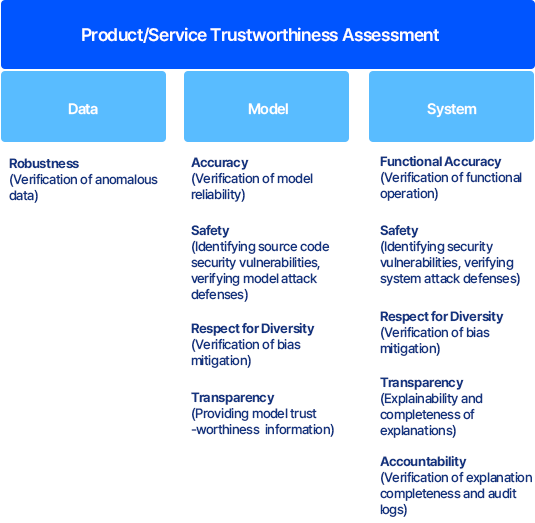
Assessment Criteria
-
On-site Assessment
-
Certification Assessment

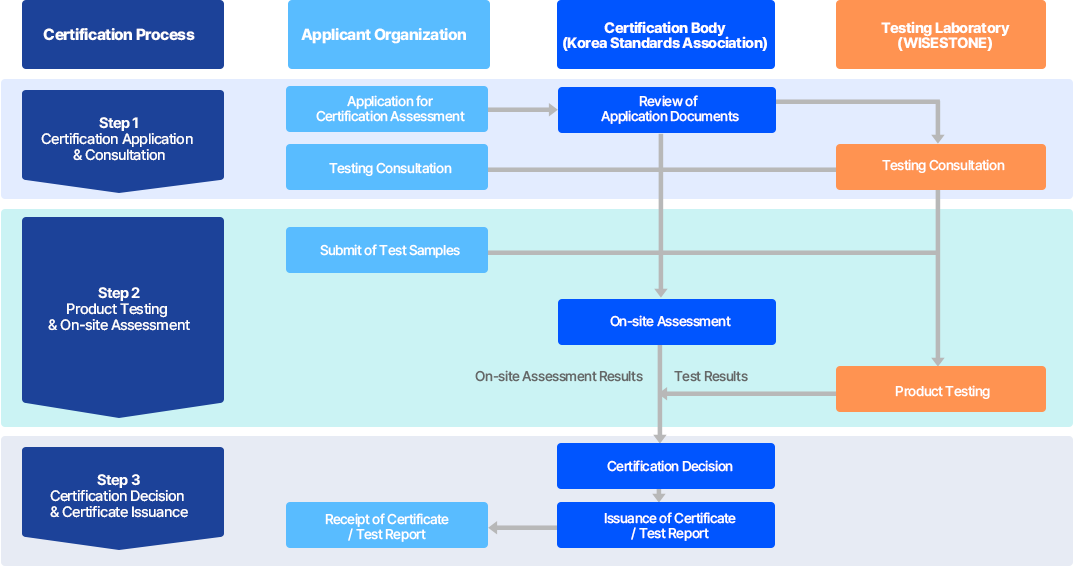
Certification Process
Contact & Consultation

-
Phone : 02-6257-5958 (Ext. : 205)
ㅣ E-mail : service@wisestone.kr
